Last Updated on July 16, 2026 by Dr. Bhagat
That email arrives — the dreaded paper rejection notification.
Your heart sinks before you even open it. Every academic, from graduate students to tenured professors, knows the sting.
But rejection doesn’t have to be your default outcome.
What if you could understand exactly why papers are rejected — straight from the perspective of journal editors?

We’ve distilled insights from 30+ journal editors, combined with publisher guidelines and peer-reviewed studies on the publishing process, into this actionable guide.
Across thousands of journals, the average acceptance rate is only ~32%, dropping to as low as 5–10% for top-tier publications. Many rejections are preventable.
This post breaks down:
- Why desk rejections happen before peer review.
- The fatal flaws reviewers spot.
- How to think like an editor.
- A step-by-step rejection-proofing checklist.
Part I: The First Hurdle – Why Paper Rejection Happens at an Editor’s Desk
Before your paper ever reaches a peer reviewer, it must pass the first and most brutal filter: the editor’s desk.
This is known as “desk rejection,” and it’s where the majority of manuscripts meet their end.
Depending on the journal, the desk rejection rate can be anywhere from a significant 18% to a staggering 81%. This is a quick decision made by an editor, often within days, that your paper will not proceed to formal review.
Passing this stage is about surviving an initial quality and relevance check. Here are the four main reasons why so many papers fail and face an early paper rejection.
The Mismatch – A Common Cause of Paper Rejection
This is the single most common reason for desk rejection, cited by editors across all disciplines.
Your research might be excellent, but if it doesn’t fit the journal’s specific focus, it will be rejected.
Journals are like ongoing, specialized conversations. An editor’s first job is to protect that conversation and serve their specific audience.
Their primary question is not “Is this good science?” but “Will my readers find this interesting, relevant, and valuable?”.
If the answer is no, the quality of your work becomes irrelevant. It’s a fundamental mismatch of purpose that results in paper rejection.
To avoid this, you must become a student of your target journal. Go beyond the title and meticulously study the “Aims and Scope” page on its website. For more tips on this, you can read our detailed guide on choosing the right journal for your research.
Then, read the abstracts—or full articles—of the last 10-15 papers the journal has published. This will give you a real-world feel for its current interests, the types of methodologies it favors, and the tone of its articles.
The Unforced Error – You Ignored the “Instructions for Authors”
After a scope mismatch, this is the next most frequent and easily avoidable pitfall.
Every journal has a detailed set of rules called “Instructions for Authors” or “Author Guidelines.”
These guidelines specify everything from word count and reference style to the required structure and file formats for figures.
Ignoring these rules is a major red flag for a busy editor. It signals carelessness, a lack of professionalism, and a fundamental disrespect for the journal’s process.
An editor facing a mountain of submissions will see a poorly formatted paper as an easy and justifiable reason to reject it.
While it might not always be the sole reason for rejection, it can compound other perceived weaknesses and tip the scales against you.
The solution is simple but requires discipline. Treat the “Instructions for Authors” as a non-negotiable contract.
Before you even think of submitting, create a personal checklist based on every single requirement in the guidelines. Tick off each item, from the abstract word limit to the image resolution, to ensure perfect compliance.
The Red Flag – Ethical Lapses Editors Spot Instantly
Before diving into your science, editors perform a series of technical checks for major ethical breaches. These are non-negotiable deal-breakers.
First, they check for plagiarism. Journals use sophisticated software to screen every submission. A manuscript showing a text duplication of around 20% might be returned for edits, but a higher percentage will lead to outright rejection and may even be reported. This includes “self-plagiarism,” where you reuse significant portions of your own previously published work without citation.
Second is duplicate submission. Submitting the same manuscript to more than one journal at the same time is a cardinal sin in academic publishing and an immediate cause for rejection.
Third are authorship issues. Editors are wary of “gift authorship” (including someone who didn’t contribute) or “ghost authorship” (excluding someone who did).
Finally, they check for procedural ethics. You must disclose all potential conflicts of interest and provide documentation of approval from your institution’s ethics committee or IRB if your research involves human or animal subjects.
Be meticulously transparent. Use a plagiarism checker before you submit. Disclose every potential conflict. Ensure all authorship and ethical protocols have been followed to the letter.
The First Impression – Poor Language and Presentation
Your manuscript’s presentation is the first signal of its quality. Papers riddled with grammatical errors, typos, and convoluted language are frequently rejected before review.
This also applies to your data. Figures and tables that are low-resolution, poorly labeled, or difficult to read will frustrate an editor and prevent a clear assessment of your work.
The editor’s logic is straightforward: if the language is so poor that the scientific argument cannot be clearly understood, the paper cannot be properly reviewed.
It creates a powerful negative first impression, suggesting that the science itself might be just as sloppy as the writing.
These surface-level issues are about more than just aesthetics. Editors are managing an immense workload and a limited pool of volunteer reviewers. They do not have time to decipher a poorly written paper or reformat a submission that ignores their guidelines.
These easily spotted errors become mental shortcuts. An editor sees a paper that is a poor fit for the journal, ignores formatting rules, or is difficult to read, and it signals that the entire review process for this manuscript will be difficult and time-consuming. It creates a high “cognitive load.”
They will often assume that such carelessness on the surface reflects a lack of rigor in the underlying science. The desk rejection, therefore, becomes an efficient way to manage their resources, freeing up time and reviewer energy for submissions that demonstrate professionalism and a high potential for impact.
Part II: Peer Review and Paper Rejection – Uncovering Fatal Flaws
If your manuscript survives the desk rejection phase, congratulations. You have already surpassed a majority of submissions and earned the right to a formal peer review.
Now, however, the scrutiny intensifies. The focus shifts from presentation and fit to the very core of your scientific contribution.
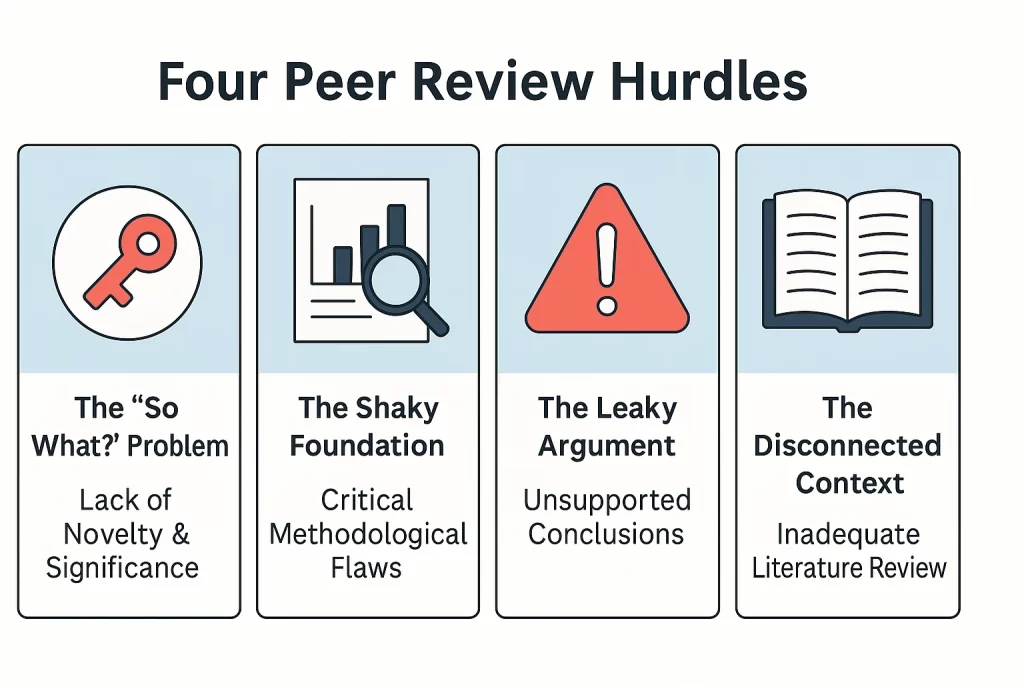
Rejections at this stage are more substantive and harder to stomach, as they come from experts in your field. Here are the fatal flaws that peer reviewers are trained to find, which often lead to paper rejection.
The “So What?” Problem – Novelty and Paper Rejection
This is, by a wide margin, the most common reason for rejection after peer review.
Your research fails to offer a new, meaningful, and important contribution to the field.
One study analyzing rejection reasons found that a lack of new or useful knowledge accounted for a majority of all rejections, making it the dominant factor.
This “novelty problem” can manifest in several ways. Your findings might simply be old news, confirming facts that are already well-established in the literature.
Alternatively, your findings might be new but incremental, offering a contribution so small that it doesn’t significantly advance the field’s understanding.
Reviewers are also on the lookout for “salami slicing,” where a single, comprehensive study is carved up into multiple “least publishable units” to inflate an author’s publication record.
Finally, your research topic itself might be outdated and no longer relevant to the current conversations and challenges in your discipline.
From an editor’s perspective, the goal is to publish work that pushes the field forward and will be cited by other researchers. A paper that lacks novelty fails this fundamental test.
To combat this, you must explicitly articulate your paper’s contribution. Don’t make the reviewer guess.
In your introduction, clearly state the “gap” in the current literature that your research is designed to fill. In your conclusion, directly answer two questions: “So what?” (why are these findings important?) and “Now what?” (what are the implications or next steps?).
The Shaky Foundation – Critical Methodological Flaws
If your novelty is clear, reviewers next examine how you arrived at your findings. Methodological flaws are considered “fatal flaws” because if the research process is unsound, the results and conclusions are unreliable.
This is a frequent cause for rejection. Common errors include a poor study design, such as lacking a clear control group or using a design that is inappropriate for testing your hypothesis.
Another major issue is insufficient data. Your sample size may be too small or too biased to produce statistically significant results or to justify the broad claims you are making.
The analysis itself is also under the microscope. Using the wrong statistical tests—or failing to use statistical analysis at all—is a classic reason for rejection.
Finally, reviewers will question your work if you use outdated methods that have been surpassed by newer, more powerful, and more robust techniques.
You must be prepared to justify every methodological choice you made. If your analysis is complex, consider consulting a statistician before you even begin your project.
Your methods section must contain enough detail for another expert to understand and replicate your study. A lack of transparency here will be viewed with suspicion.
The Leaky Argument – Unsupported Conclusions & Poor Structure
A paper can have a novel idea and a sound method but still be rejected if the argument is illogical or poorly constructed.
The most common failure here is overinterpretation of the results. This happens when authors make grand claims that go far beyond what their data can actually support.
Similarly, reviewers will reject a paper if its conclusions are simply inaccurate or not justified by the findings presented in the results section.
The structure of the paper is also part of the argument. A manuscript with a confusing, illogical flow, meaningless subheadings, or a lack of clear signposting will be rejected for “poor argumentation” because it fails to make a convincing case. For a deeper dive, check out our guide on how to write a convincing research argument.
Ensure a clear, logical thread runs from your introduction to your conclusion. Every single claim made in your discussion and conclusion must be directly traceable to a specific piece of data in your results section.
Use descriptive headings and clear transition sentences to guide the reader through your logic, step by step.
The Disconnected Context – Inadequate Literature Review
Your research does not exist in a vacuum. A paper will be rejected if it fails to properly situate itself within the existing body of knowledge in your field.
A frequent error is relying on outdated references. This signals to reviewers that you are not engaged with the most recent developments in your field.
Another red flag is an over-reliance on self-citation. While citing your own relevant work is normal, citing it excessively suggests a narrow and biased view of the literature.
Most critically, a literature review will be deemed inadequate if it omits key studies, especially those that might contradict your own findings. This suggests either ignorance or an unwillingness to engage with competing ideas.
Conduct a thorough and up-to-date literature search before you write. Your introduction must demonstrate to reviewers that you have a comprehensive understanding of the state of your field and can clearly explain where your unique contribution fits in.
The reasons for paper rejection after peer review are not isolated incidents. They are often symptoms of a “chain of failure” that begins long before the first word of the manuscript is written.
This chain often starts with a weak or unclear research motive. Without a compelling “why” driving the study, the subsequent literature review becomes unfocused and fails to identify a genuine gap in knowledge, leading to a lack of novelty.
This poorly defined problem then leads to the selection of an inappropriate or weak methodology. A flawed methodology inevitably generates incomplete or unreliable data, which in turn can only support weak and overinterpreted conclusions.
The rejection letter you receive, citing unsupported conclusions, is therefore just the final link in a chain that started with a flawed premise. This reveals that the most effective way to avoid paper rejection is not to fix the paper at the end of the process, but to rigorously design the research project from the very beginning.
The Ultimate Paper Rejection-Proofing Checklist
| Rejection Reason (The “Why”) | Actionable Solution (The “How”) |
| Desk Rejection: Poor Journal Fit | Analyze the “Aims & Scope” page and the last 10-15 articles published in your target journal to confirm alignment. |
| Desk Rejection: Ignored Guidelines | Create a personal checklist from the journal’s “Instructions for Authors” and tick off every item before submission. |
| Desk Rejection: Ethical Red Flags | Run your manuscript through plagiarism detection software. Disclose all conflicts of interest and confirm all ethical approvals are in place. |
| Desk Rejection: Poor Presentation | Ask a trusted colleague or use a professional editing service to proofread for language, clarity, and grammar before submitting. |
| Peer Review: Lack of Novelty | Before writing, articulate in a single sentence what your paper adds that no other paper has. This is your “contribution statement”. |
| Peer Review: Flawed Methodology | Justify every choice in your methods section. If using statistics, have an expert review your analysis plan before you collect data. |
| Peer Review: Insufficient Data | Ensure your sample size is large enough to support your claims. If necessary, conduct a power analysis to determine the appropriate sample size. |
| Peer Review: Unsupported Conclusions | For every claim in your conclusion, highlight the specific sentence or data point in your results section that directly supports it. |
| Peer Review: Inadequate Lit Review | Ensure your references are current. Explicitly address how your work relates to the most important and recent studies in your field, including contradictory ones. |
Part III: Inside the Editor’s Mind – What They Really Want
To truly master the submission process, you must move beyond avoiding mistakes and start thinking like an editor. Understanding their pressures, priorities, and pet peeves can give you a powerful strategic advantage against paper rejection.
Their Primary Role – Guardian of Quality and Reader’s Time
First and foremost, an editor’s primary loyalty is not to you, the author. It is to the journal’s readers and its scientific reputation.
They see themselves as curators of knowledge. Their job is to ensure that only the “best of the best research” makes it into the pages of their journal.
This is not about elitism; it’s about service. They are protecting their readers from wasting precious time on research that is outdated, flawed, or insignificant.
Therefore, you should frame your submission not as a personal request for publication, but as a valuable contribution that will enhance the journal’s reputation and provide a genuine benefit to its readers.
Their Pet Peeves – Signs of Disrespect for the Process
Editors are experts at spotting authors who are trying to game the system or are simply not putting in the required effort.
They can easily identify “salami slicing” and see it as an attempt to bloat a CV rather than make a genuine scientific contribution.
They are frustrated by papers that are “overcrowded with ideas” and lack a single, clear focus. This suggests an author who is undisciplined in their thinking and writing.
And one of the biggest mistakes an author can make is to respond to reviewer comments defensively or dismissively during the revision process. This signals an unwillingness to engage with constructive criticism and is a fast track to a final rejection.
Their Unspoken Plea – Make My Job Easier
The academic peer review system is notoriously slow and inefficient. A huge portion of an editor’s job involves administrative tasks, managing submissions, and constantly nagging experts to complete their reviews.
They are overworked, under-resourced, and managing a difficult process.
Given this reality, a manuscript that is clean, well-organized, follows all the rules, and presents a clear, easy-to-grasp argument is a gift.
A paper that is easy for them to handle is far more likely to move smoothly and successfully through the system.
Ultimately, the most successful authors adopt a “partnership” mindset. They do not view the editor as an adversary to be conquered, but as a potential collaborator in the dissemination of knowledge.
By understanding the editor’s goals—publishing novel, high-impact work—and their constraints—limited time and resources—you can strategically frame your manuscript to align with their needs. When you submit a clear, well-written paper that perfectly fits the journal’s scope and follows every guideline, you are not just helping yourself. You are helping the editor do their job effectively.
This transforms the submission from a simple, one-sided request into a professional, collaborative effort, dramatically increasing your odds of a positive outcome and avoiding paper rejection.
Part IV: Your Action Plan – From Rejection to Resubmission
Knowledge is only powerful when it is applied. This final section provides a concrete action plan to help you prepare your next submission and handle the review process constructively.
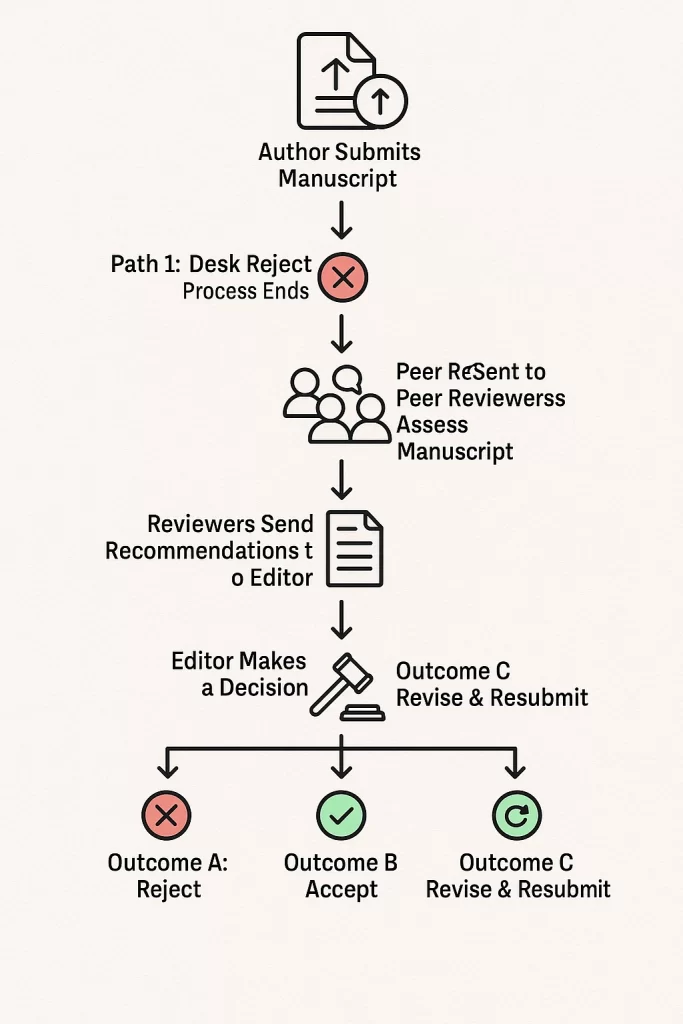
The Pre-Submission Audit
Before you click that “submit” button, perform one final, rigorous self-check. This is your chance to act as your own desk editor and catch preventable errors.
First, does your paper pass the “wrong journal” test? Re-read the aims and scope and be brutally honest with yourself about the fit.
Second, have you checked your manuscript against your “Instructions for Authors” checklist? Is every single guideline met?
Third, has a fresh pair of eyes seen it? Ask a trusted colleague to read it for clarity, or consider using a professional language editing service if you are not a native English speaker. For more guidance, resources like Springer Nature Author Services offer extensive support for researchers.
Finally, is your “So What?” contribution crystal clear? Can a reader understand your paper’s main takeaway from the first few paragraphs of the introduction?
Decoding Reviewer Comments and Crafting the Rebuttal
Receiving a “Revise and Resubmit” decision is not a failure. It is a very positive sign that the editor and reviewers see potential in your work and are inviting you to improve it. Your response is critical.
First, always be polite, professional, and scholarly in your tone. Never respond emotionally or defensively, even if you feel a review is unfair.
Address every single comment from every reviewer. The best way to do this is in a separate “response to reviewers” document. Copy and paste each reviewer comment, and then below it, write a detailed response explaining the change you made.
Make it easy for them to see your work. In the revised manuscript itself, use Microsoft Word’s “Track Changes” feature, colored text, or highlighting to clearly indicate where revisions have been made.
If you genuinely disagree with a reviewer’s suggestion, you can make a case for your original approach. However, you must do so politely and provide a rational, evidence-based argument to support your position.
The Proactive Advantage – Optimizing Your Paper for Discovery (SEO)
In the digital age, getting published is only half the battle. You also want your work to be found, read, and cited. This is where academic Search Engine Optimization (SEO) comes in.
This is not about tricking algorithms. It’s about making your paper more discoverable to both search engines and human readers.
Start by choosing three to five specific keywords or short phrases that a researcher would use to search for a paper on your topic. You can use free tools like Google Trends or Answer the Public to see what terms people are actually using.
Next, craft a title that is clear, descriptive, and includes your most important keywords. Avoid overly clever or jargon-filled titles that no one would search for.
Finally, power-up your abstract. The abstract is one of the most important elements for search engines. Ensure your keywords appear naturally within it, paying special attention to the first sentence, as this is often what appears directly in Google search results.
What is good for Google is often good for an editor. A clear, keyword-rich title and abstract do more than improve your paper’s long-term visibility. They also make its topic and relevance immediately obvious to a busy editor screening hundreds of new submissions.
Conclusion: Make Paper Rejection the Exception, Not the Rule
Rejection is, and always will be, a part of academic life. The path to publication is paved with them.
However, a significant portion of these rejections do not stem from fatal scientific flaws. They arise from preventable errors in preparation, a lack of strategy, and a fundamental misunderstanding of the editorial process.
The power to dramatically increase your chances of acceptance and avoid paper rejection lies with you, the author.
By adopting a professional, strategic, and empathetic approach—and by treating your submission not as a lottery ticket but as the final, critical step of your research project—you can transform that dreaded rejection letter into a rare occurrence.
Use this guide. Use the checklist. And approach your next submission with the confidence that comes from true insight.